
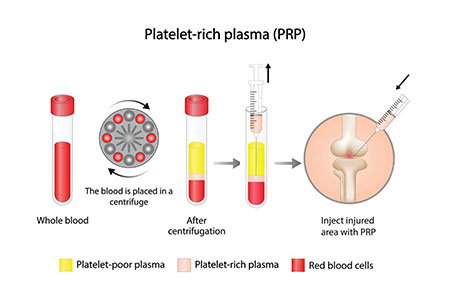
 Platelet Rich Plasma (PRP) is the next generation of innovation in Regenerative Medicine. In our many years of using Regenerative Medicine, we have found PRP to be most effective when custom made for each patient and used with an Integrative Medicine approach.
Where Prolotherapy attracts the healing (fibroblast) cells to the site of injury, PRP helps optimize the conditions for this healing to take place. By releasing growth factors at the site of injury in customized concentrations from your body’s own platelets in your blood, the regeneration and repair can be optimized using the vital assistance of your body’s own stem cells.
A study titled “Platelet-Rich Plasma vs Prolotherapy in the Management Of Knee Osteoarthritis: Randomized Placebo-Controlled Trial” was a prospective trial comparing intra‑articular PRP, dextrose prolotherapy, and placebo injections for knee osteoarthritis.
Main findings: Both PRP and prolotherapy groups had significantly greater pain and function improvements than placebo. PRP tended to show somewhat larger or faster improvements than prolotherapy, but both were clinically beneficial vs control.
Takeaway: For knee OA, both PRP and dextrose prolotherapy outperform placebo; PRP MAY have an edge in some outcome measures, but prolotherapy is also effective.
…………………………………………………………………………………………………………………………………………………………………………………
Intra‑articular PRP vs 25% dextrose prolotherapy – knee OA (comparative trial)
Design: Comparative clinical study of intra‑articular PRP vs 25% hypertonic dextrose prolotherapy for knee osteoarthritis.
Sample: 85 participants (43 PRP, 42 prolotherapy).
Main findings: Both groups showed improvement in pain and function over follow‑up.
PRP generally produced greater reductions in pain scores and better functional outcomes than dextrose prolotherapy at several time points.
Takeaway: In this knee OA cohort, PRP appears superior to high‑concentration dextrose prolotherapy overall, but both provided benefit.
The comparative effects of injecting intra-articular platelet-rich plasma and hypertonic dextrose prolotherapy in osteoarthritis knee – A randomized control trial
J Family Med Prim Care. 2025 Jun 30;14(6):2180–2186.
https://pmc.ncbi.nlm.nih.gov/articles/PMC12296247/
…………………………………………………………………………………………………………………..
PRP versus Prolotherapy for Knee Osteoarthritis
Results suggested a significant decrease in the overall WOMAC score of patients who undergo either PRP therapy or prolotherapy. This positive change in the overall WOMAC score led to an improvement in the quality of life of patients with knee osteoarthritis shortly after the first injection. PRP injection was found to be more effective than PRL in the treatment of knee osteoarthritis in this study.
The effects of injecting intra-articular platelet-rich plasma or prolotherapy on pain score and function in knee osteoarthritis; Clin Interv Aging. 2018 Jan 4:13:73-79.
https://pubmed.ncbi.nlm.nih.gov/29379278/
……………………………………………………………………………………………………………………………………
Shoulder
Rotator cuff / shoulder tendinopathy
PRP vs dextrose prolotherapy – partial rotator cuff tears (prospective randomized controlled trial)
Design: Randomized trial comparing ultrasound‑guided PRP vs dextrose prolotherapy for partial‑thickness rotator cuff tears.
Outcome measures: Numeric Rating Scale for pain and UCLA shoulder score, followed up to 12 weeks.
Main findings: Both PRP and prolotherapy groups had significant reductions in pain and improved shoulder function at 8 and 12 weeks compared with baseline.
No statistically significant differences were found between PRP and prolotherapy groups at any follow‑up point.
Takeaway: For partial rotator cuff tears over short‑term follow‑up (up to 12 weeks), PRP and dextrose prolotherapy performed equivalently for pain and function.
Role of platelet-rich-plasma versus dextrose-prolotherapy in the management of partial rotator cuff tear- A randomised controlled trial. Indian J Anaesth. 2022 Mar;66(Suppl 1):S34–S35.
https://pmc.ncbi.nlm.nih.gov/articles/PMC9116806/
…………………………………………………………………………………………………………………………..
PRP vs prolotherapy vs saline – chronic supraspinatus tendinopathy (Rotator Cuff Tendinopathy)
Design: Randomized, double‑blind trial of PRP, dextrose prolotherapy, and normal saline injections in chronic supraspinatus tendinopathy.
Methods: Ultrasound‑guided injections; follow‑up at several time points; pain (VAS) and functional scores (e.g., SPADI) assessed.
Main findings: Both PRP and prolotherapy groups had meaningful reductions in pain and improved shoulder function compared with baseline and vs saline control.
Differences between PRP and prolotherapy were small; both were effective, with no clear, consistent superiority of one over the other across all measures.
Takeaway: In chronic supraspinatus tendinopathy after failed conventional care, PRP and prolotherapy both improved outcomes; neither clearly dominated.
The Effects of Platelet-Rich Plasma vs Prolotherapy Injection on Functional and Pain Scores in Supraspinatus Tendinopathy: A Randomized Controlled Trial. 23RD AUGUST 2019
https://cdn.clinicaltrials.gov/large-docs/62/NCT04640662/Prot_SAP_001.pdf
………………………………………………………………………………………………………………………………
A study done on PRP for chronic rotator cuff tendinopathy and reported on in the American Journal of Sorts Medicine found that “at 1-year follow-up, a PRP injection was found to be no more effective in improving quality of life, pain, disability, and shoulder range of motion than placebo in patients with chronic RCT who were treated with an exercise program.”
Am J Sports Med. 2013 Nov;41(11):2609-16.
Platelet-rich plasma injections in the treatment of chronic rotator cuff tendinopathy: a randomized controlled trial with 1-year follow-up
Kesikburun S, Tan AK, Yilmaz B, Yaşar E, Yazicioğlu K. Platelet-rich plasma injections in the treatment of chronic rotator cuff tendinopathy: a randomized controlled trial with 1-year follow-up. Am J Sports Med. 2013;41(11):2609-2616.
https://pubmed.ncbi.nlm.nih.gov/23893418/
…………………………………………………………………………………………………………………………………..
Elbow
Lateral epicondylosis (tennis elbow)
Design: Prospective, randomized controlled trial comparing PRP, dextrose prolotherapy, extracorporeal shockwave therapy (ESWT), and physiotherapy in chronic lateral epicondylosis, with 2‑year follow‑up.
Main findings: Both PRP and prolotherapy groups had significantly better pain and functional outcomes than ESWT and physiotherapy at 2 years.
PRP and prolotherapy performed similarly overall; the study’s main conclusion was that both regenerative injections were superior to the non‑injectable modalities tested.
Takeaway: For refractory lateral epicondylosis, PRP and prolotherapy are both effective long‑term options; the trial did not show one clearly outperforming the other.
Comparing the Use of Physiotherapy, Shockwave Therapy, Prolotherapy, and Platelet-Rich Plasma for Chronic Lateral Epicondylosis: A Prospective, Randomized Controlled Trial With 2-Year Follow-up Am J Sports Med. 2025 Sep;53(11):2707-2714.
© Copyright 2026. All rights reserved.